
Image
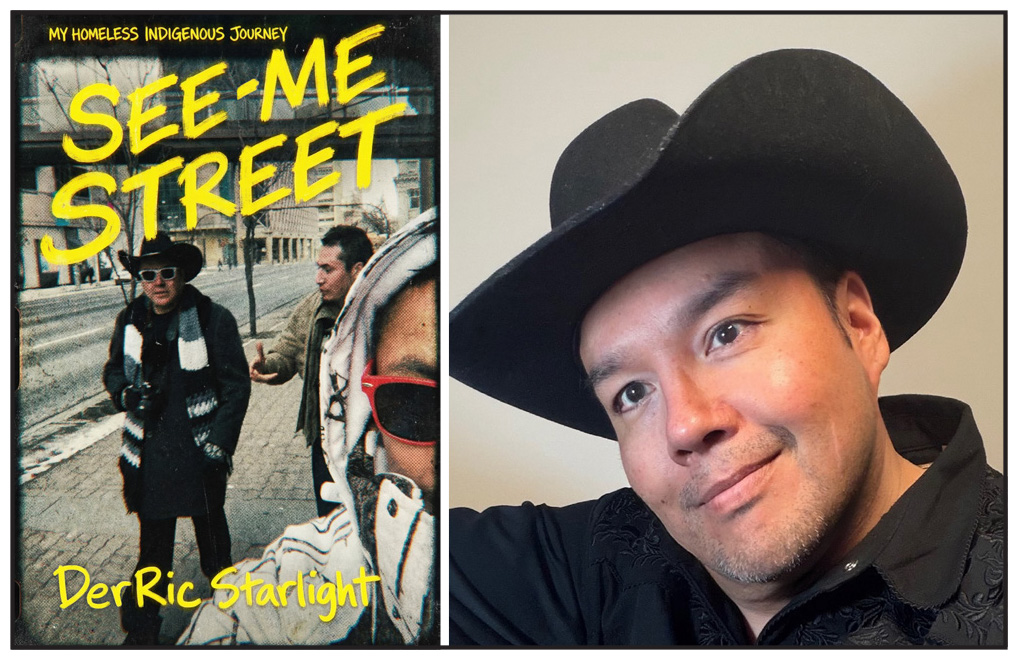
Image Caption
Windspeaker.com Books Feature Writer
Local Journalism Initiative Reporter
Despite the toll living rough had on his health, entertainer DerRic Starlight says he has no regrets about the street project he undertook over the course of three years.
In his book SEE-ME STREET My Homeless Indigenous Journey, Starlight chronicles in stark terms and brutal honesty the reality of his time living as a homeless person in Lethbridge, Calgary and Edmonton. The book ends with a list of 19 “street family” members who died.
Spurred on by the 2011 film Super Size Me, in which documentarian Morgan Spurlock ate McDonald’s for 30 days to show the impact fast food had on the body, Starlight initially decided to immerse himself in the world of the homeless for a month, spending two weeks in Lethbridge and two weeks in Calgary. His intent was to write a book and draw attention to people living on the margins. Later, he added Edmonton in the winter to his experience.
Starlight, a member of the Tsuut’ina Nation, was in his mid-30s in 2014 when he took on the project. At the time he lived what he called an “Elvis Presley Lifestyle”, riding high as a puppeteer, stand-up comedian, screenwriter, award-winning voice actor, and a wrestling promoter. But he had also turned to alcohol to deal with the loss of two partners in quick succession.
As he writes, “I spent time with Indigenous men across the country talking about broken relationships and depression… The stories were different, but the roots were often the same—generational pain passed down from residential schools, abuse, loss of language, loss of love…These were men carrying generations of weight.”
Wanting to write the story of these men who found themselves on the streets, Starlight decided to immerse himself in the experience. That he ended up in the hospital and detox treatment numerous times was to be expected, he says.
“It helped me. It healed me. This is a healing journey that I went through. After I stopped, when I left the street, and I'm now almost 10 years of sobriety, I've never touched a drink or a cigarette or anything like that ever again after I went through that,” said Starlight.
Through diary entries, interviews, narrative, and black and white photos, Starlight provides a shocking insider’s view into life in detox centres, homeless shelters and off-the-book sleeping spots.
The term “see-me street” is ghetto slang, he says, for “you’ll see me on the street.”
As Starlight’s late friend Bobby explained, “See-Me Street means a lot of things. Can you see me on the street? See me fight on the street? See me survive the street? Can you see me? I am the street!”
What Starlight soon learned was that a community was formed amongst street people. They looked out for each other and took care of each other.
“It becomes an Indigenous Native community down there, all the cities that I went to, Lethbridge and Calgary, Edmonton. And what amazed me the most out of all of it was how they know each other in all these cities,” he said.
In Edmonton, Starlight was dubbed with the street name Hulkster after doing an impression of his hero Hulk Hogan. On his return to Calgary, the street name had preceded him.
“To be called the Hulkster…that made me feel good getting that name,” said Starlight. “It has to come with a ghetto slang or something like that when it comes to nicknames because it's very rarely that they call each other by their first names. They just get a nickname and then that will stick because a lot of them probably forget what their real names are.”
Starlight wrote SEE-ME STREET years after his homeless project ended. He said he needed time for recovery and to re-educate himself in film school and acting school. When COVID hit in 2020 he started organizing the book. It took him three years to write it.
Revisiting his diary entries, notes and memories was “emotional,” especially writing about Bobby, who came from Maskwacis in central Alberta. After recovery, Starlight worked with Bobby to help him enter a career in entertainment.
“I really highly expected him to become a great performer, because that's what he was, and to write about his demise it was just so, reliving it again, it's so very sad. But it makes me happy that his story was being told the way he wanted it to be, that he wasn't just an alcoholic down there. He was an entertainer. I (saw) him try several times, and he was successful many, many times. But he was a young person. If he tried (detox) a couple more times, he would have been successful. I have no doubt,” said Starlight.
Starlight is hopeful that SEE-ME STREET will help the public understand street people as more than the addictions or mental health issues that have left them unhoused.
“This (book) is for Indigenous people. It's just the start of making a difference, writing about it and telling their stories. And there are Indigenous Native people like myself who are trying to help people get out of there,” he said.
SEE-ME STREET My Homeless Indigenous Journey is part of the Indigenous Spirit Series published by Durvile & UpRoute. The book launch will be held June 11 in Calgary. See-Me Street can be ordered at https://durvile.com/books/SeeMe.html