
Image
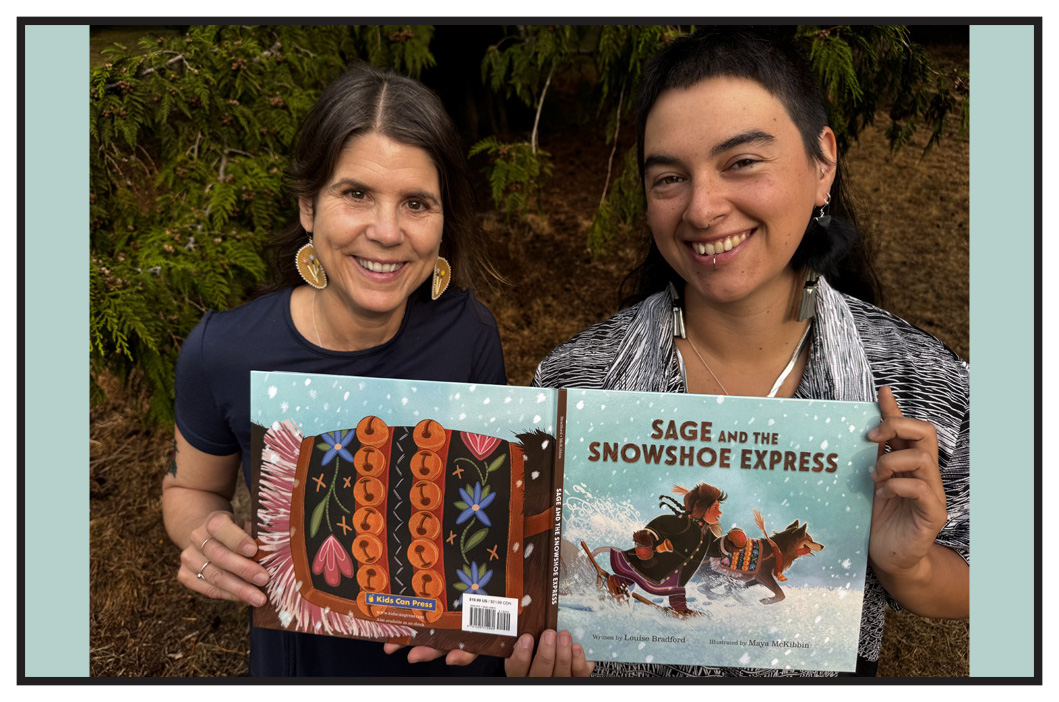
Image Caption
Windspeaker.com Books Feature Writer
Local Journalism Initiative Reporter
A side note in a Library and Archives Canada document indicated that her great-great-grandfather Raymond Miron was a snowshoe mail carrier, and this led to author Louise Bradford’s new children’s book Sage and the Snowshoe Express.
A member of Batchewana First Nation in northwest Ont., Bradford admits she didn't understand the extent of her great-great-grandfather’s work and its importance. Research led her to a book about Ojibwe snowshoe mail carrier John Beargrease from Minnesota who did his work on the American side of the same territory.
Raymond Miron and his brothers carried mail in the rugged winter territory along Lake Huron and Lake Superior in the mid- to late 1800s.
Author Daniel Lancaster in John Beargrease: Legend of Minnesota's North (2008) describes snowshoe mail carriers as heroes who took on the “extreme rigors of the perilous route.”
Lancaster depicted isolated, remote, newly settled communities that desperately awaited the snowshoe mail carrier who brought communication from the outside world along with gossip from the homes up and down the shoreline.
That’s the story Bradford tells of villagers deep in the woods and cut off from everything. There’s the baker who’s awaiting more maple sugar; the grandmother fretting over news about the new baby’s arrival; and the little boy whose teddy can’t be patched because there’s no more thread.
Initially it was Bradford’s thought that a story on the snowshoe express would appeal to children four to eight years of age through sled dog Nimoosh. However, feedback from an editor with publishing house Kids Can Press said a young person was needed in the story. That was how Sage was created.
“I thought of my great-grandmother being a little girl,” said Bradford. “I didn't know much about my great-grandmother. I don't know what kind of adventurous spirit she had but I gave her one in this imagination.”
Sage is forced to accompany her father and Nimoosh on the wintertime trek when her dad drops a parcel. As her father’s motto is “No mail left behind,” Sage has no choice but to swish quickly in her snowshoes to catch up with him. And so begins her adventure which includes Sage having to make use of the ever-present bell that she rings to scare away the wolves. The bell is also used to let villagers know their snowshoe carrier is close by.
The book is peppered with Anishinaabemowin words and includes a glossary. It’s important to keep the language alive, said Bradford, who four years ago began learning Anishinaabemowin in Vancouver where she now lives.
“I fell in love with the language, about how it is so rooted in nature. The importance of nature and the beauty of nature and protecting nature. And everything just made so much sense to me,” said Bradford.
Sage and the Snowshoe Express is illustrated by Maya McKibbin, two-spirited with Irish-settler and Ojibwe roots in White Earth Nation in Minnesota. Bradford says they worked together closely on the book and illustrations provide a nod to Métis and Inuit.
“It is an Anishinaabe story, but it's not just an Anishinaabe story. It's to honour all Indigenous mail carriers,” said Bradford.
Sage and the Snowshoe Express is introduced with a letter from former Batchewana First Nation Chief Dean Sayers. He writes that Bradford “honors her ancestors, the mail carrier, and the skills, knowledge, courage and culture of all Anishinaabeg.”
Bradford explains that every year Sayers holds a four-day ceremony in Nanabozho, traditional Anishinaabe land within Lake Superior Provincial Park in Ontario. A few years ago, Bradford took part in the ceremony. In discussion it came out that she was writing a book about a snowshoe mail carrier. One of her ceremony companions said her great-great-grandfather was also a snowshoe mail carrier. It turned out the two women were cousins and the two great-great-grandfathers were brothers.
Bradford has been sharing her work with her cousin Peggy and will be gifting a copy of Sage and the Snowshoe Express to her at the book launch next month at the Bush Plane Museum in Bradford’s home community of Sault Ste. Marie. Sayers will also be a special guest.
Bradford says it’s especially important to capture this story of the snowshoe mail carrier as the men who were employed by the government couldn’t display any outward expressions of their cultures.
“Their jobs literally would have been at risk, I think, so this is a really important way for us to reclaim and retell the narrative of the family,” she said.
And perhaps it’s only fitting that Bradford is the one to tell the story. A few years ago she was given the Anishinaabe name of Diindiisi Ikwe, which means Blue Jay Woman. Bradford was happy with the name but didn’t fully understand it. A day or two after receiving the name, she attended a Sunrise ceremony.
“The Elder giving the opening remarks started with, ‘I want to thank the blue jays for their call, for telling everyone something important is happening.’ And I just couldn't believe it. I'm like, ‘That's it.’ As a writer for me, that's why it's so important. That's why I love it. This is what telling the story, something important, is happening,” she said.
Sage and the Snowshoe Express is published by Kids Can Press and will be released Sept. 1. It can be purchased at https://www.indigo.ca/products/sage-and-the-snowshoe-express