
Image
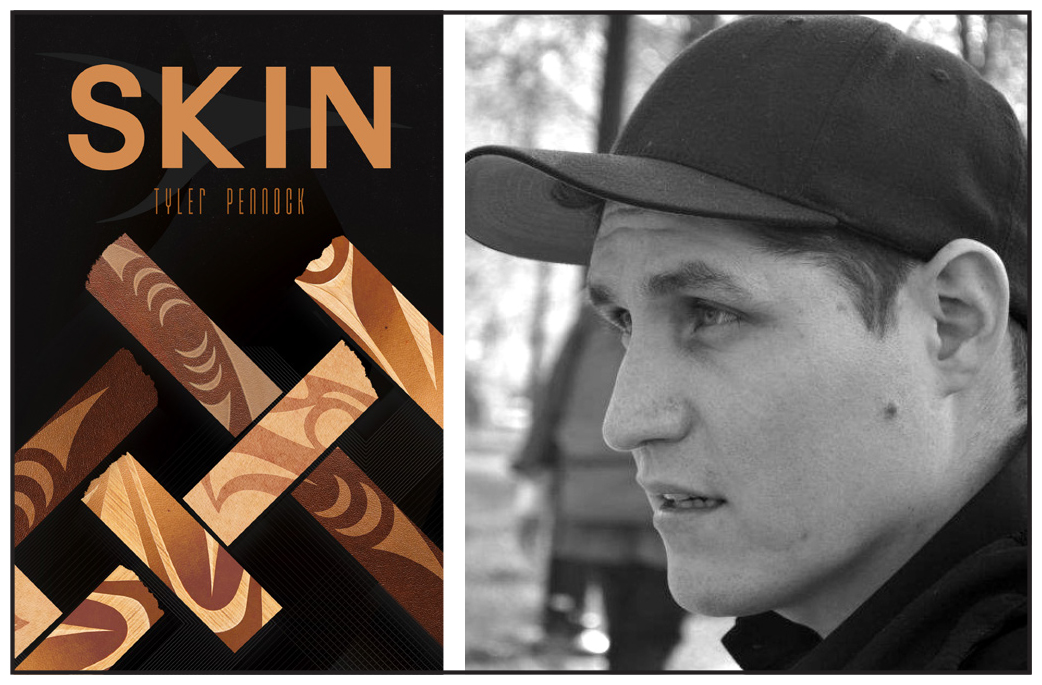
Image Caption
Windspeaker.com Books Feature Writer
Local Journalism Initiative Reporter
Skin, Tyler Pennock’s final collection of poetry in their trilogy, ends a journey that began more than 20 years ago.
“Skin just…flowed. And it felt too easy, if I'm honest. It felt like I was being lazy, but I wasn't because there was so much background put into the other two books,” said Pennock, a two-spirit adoptee and member of Sturgeon Lake Cree Nation in northern Alberta.
Skin is preceded by Bones, released in 2020, and Blood, published in 2023.
The first poem in Bones was written in 2005, while other poems weren’t written until 2015.
“And Blood was like it had to come out. Blood comes from bones, like physiologically. I wanted to capture that it was necessary for Bones to set the stage of what memory does and what trauma does and what relationships are,” said Pennock. “Blood became this understanding…(of) one's early adult life in the context of having finally done that. And then Skin just grew on its own.”
Skin is about the scars that the flesh reveals, the stories behind those scars, and the time it takes to understand them.
“The one trauma that hovers over all of this, over all of the traumas…from abuse through sexual abuse to prostitution…is the adoption. Adoption is a violent act because of what it does to the mother and child,” said Pennock, who was a victim of the Sixties Scoop. The Sixties Scoop ran from the 1950s to the 1980s and saw Indigenous children taken from their parents and placed with white families in Canada and the United States.
“Did I need to heal? Absolutely. And was (Skin) about healing? It's more of a storing of healing through…the final big tent, the adoption. Which, I wouldn't be here if I wasn't adopted. But also, there's got to be better options than what they pulled off,” Pennock said.
It took Pennock about 11 months of “hardcore writing” to pen Skin, though they “sat on” material for a few months that had collected over a couple of years of discussions with biological aunts and uncles.
“I noticed that everyone's recollections of what happened when they were kids when my grandfather died are all different. They're all coming from a completely different perspective. I was like, ‘How does that jibe? How do you knit all that together because you don't dismiss someone's perspective’,” said Pennock. “Everyone had a different understanding of it because their lives changed the memories.”
Those memories included sexual abuse experienced by Pennock’s mother and younger aunts and uncles in a context different from the violence and abuse experienced by the older siblings.
“When you write a book of poems or fiction, you always have someone in mind that you're writing to. And I realize (Skin) is to all the fathers in my life who I was never close with. And I'm like, ‘This is a story I'm laying out for you that is well beyond your knowledge’,” Pennock said.
Pennock met his biological father and mother in 2007. They no longer speak with their biological father.
The words Pennock chooses for their poems are important, but so too is how they place the poems on the page using space to imply a time to pause and slow down when reading.
Whether poems are titled is also a choice. Some poems are called “untitled” with multiple plays on the word such as “untitled*”, “un_titled”, or “_titled”. Some poems have the title placed within the text.
Then there are poems in Skin that are either physical overlays of poems from Bones and Blood or extensions of poems from the previous two works.
Those poem extensions, said Pennock, “are a translation to me of memory and trauma from one understanding to the next. So that our traumas, our stories, are a part of the body and they change their medium based on how they represent themselves in the body. So for Skin, it's a scar. For Blood, it's more like a memory and a behaviour. And for Bones, it's like the context on which we experience our lives. That was what I was going for. And the freaky-deaky thing is that I didn't really understand that until I wrote Skin.”
Pennock is pleased with the final results.
“Skin is such an accomplishment for me, and I love it so much,” they said. “Every time I look at these poems, I see connections to each poem, to all the poems between and intertextual that I didn't see necessarily when I read them. I wrote them. And it's beautiful to me that I did this and I thought, ‘Wow, this is how any oral tradition works.’ It's specific to me. It's specific to my writing. People will get something else out of it…But every time I look at it, it's something new that I didn't realize I put there.”
While Pennock says they don’t anticipate endings, Skin “definitely ended in a place I'd imagined it would be.”
It also sets up the next stage in their journey.
Pennock said their next poetry collection will be called Breath, but they’ll be “sitting with” it for at least 10 years.
“Breath would be technically a fourth part, but it's not part of the body. It's what we leave (behind) when we leave,” they said. “It's like stories, right? Stories are what remains after our bodies are gone…The breath part of the oral tradition…it signals that there's something special to us that isn't physical.”
Skin is published by Brick Books and will be released Oct. 6. It can be purchased through https://www.brickbooks.ca/shop/skin-by-tyler-pennock/