
Image
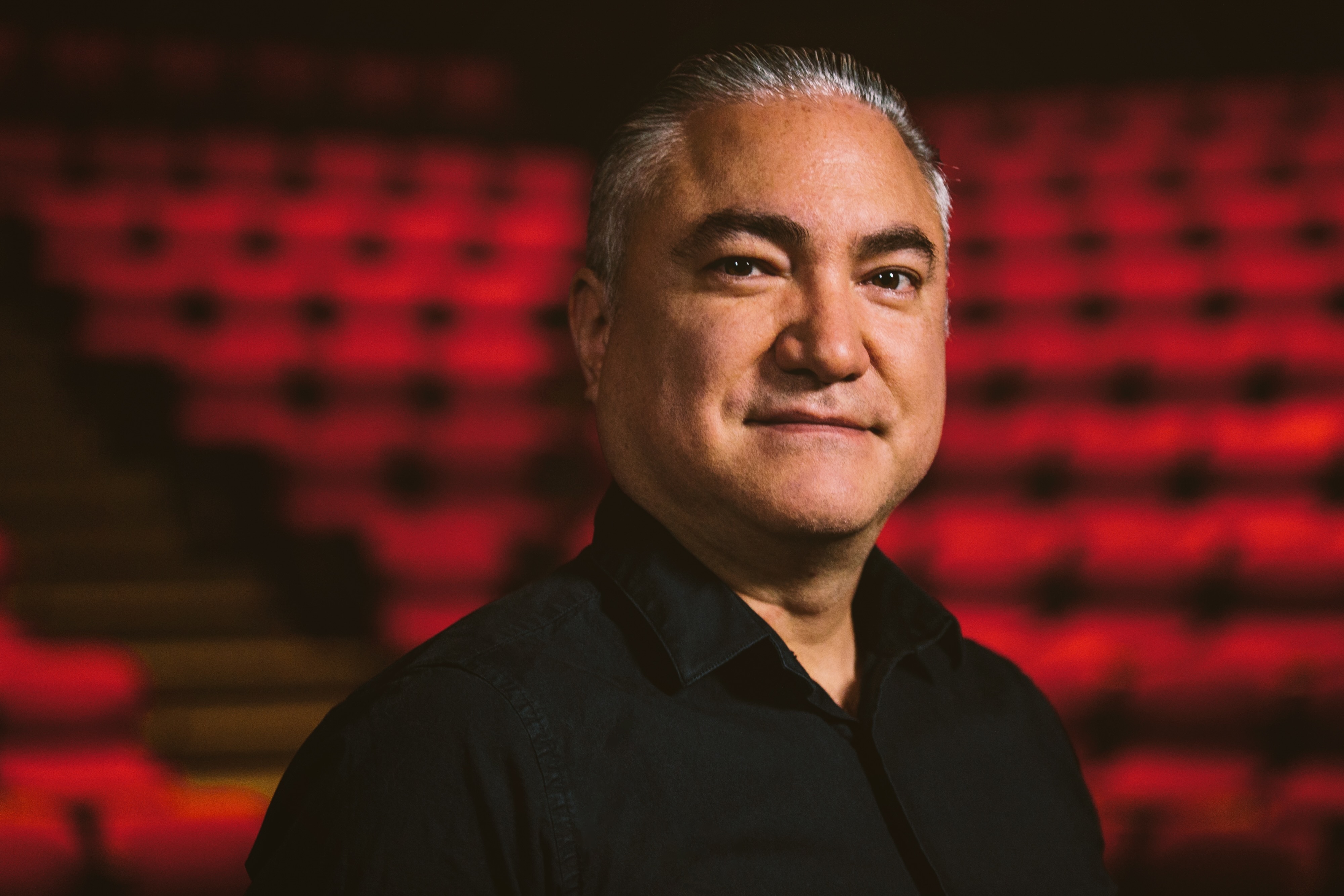
Image Caption
Local Journalism Initiative Reporter
Windspeaker.com
Nearly two decades after its Vancouver premiere, Kevin Loring's award-winning play Where the Blood Mixes has returned to the city's Firehall Arts Centre. The play will run until Dec. 6, this time with the N'lakap'mux playwright directing it for the first time.
Blending dark humour with themes of loss and redemption, the deeply personal play explores the intergenerational impacts of Canada's residential school system.
After premiering at Toronto's Luminato Festival in 2008, it's performance at the Magnetic North Theatre Festival in Vancouver a few days later coincided with Prime Minister Stephen Harper's historic formal apology for that system.
Earning a thunderous standing ovation, the play was an instant hit. In 2009 it won the Governor General’s Literary Award for Drama, the Jessie Richardson Theatre Award for Outstanding Original Script, and the Sydney J. Risk Prize for Outstanding Original Script by an Emerging Playwright.
“It toured the country in 2010 and is taught in high schools and universities across the land,” Loring told Windspeaker. “Many people find it really powerful and moving, hard in places but also with a lot of heart. It's interesting to revisit it in this era when we are much more familiar with the history of residential schools.”
Since the play's debut, Loring has appeared as an actor in several film, television and theatre productions and written the plays Little Red Warrior and His Lawyer, Battle of the Birds, Thanks for Giving and The Boy Who Was Abandoned. In 2017, he became the first artistic director of Indigenous theatre at the National Arts Centre in Ottawa.
Under Loring's leadership, the NAC has commissioned hundreds of Indigenous artists and championed numerous works celebrating Indigenous languages and storytelling, such as The Breathing Hole, a theatre work translated into an at-risk dialect of Inuktut and created in close collaboration with Inuit knowledge keepers.
Last spring, when conversation shifted to Where the Blood Mixes during a massive production of Tomson Highway's ambitious musical Rose, Loring declared that the next time Where the Blood Mixes was staged he would be the director. The next month, he got a call from Firehall Arts Centre artistic producer Donna Spencer to do just that.
“The play’s story remains deeply relevant,” said Spencer. “Kevin Loring’s powerful account of one family’s journey toward reunification is filled with emotion, laughter and hope.”
The production has often been called a love letter to Lytton, BC, which is located at the confluence of the Thompson and Fraser rivers. Its title refers to the town’s Nlaka’pamux name, Kumsheen, typically translated as “where the rivers meet” but which Loring learned means “the place inside the heart where the blood mixes.”
Growing up in the shadow of St. George’s Residential School, he recalled his uncle telling them as kids to stop playing on its coal mound because that's where they buried the suicides. One of the country's first cases against the church and federal government for residential school abuses was initiated by survivors of that institution.
The characters in Where the Blood Mixes are all residential school and suicide survivors, battling ghosts from their past when a girl that was taken by social services returns home 25 years later to confront her father and learn her history.
“I wrote the play as a way of exorcising those invisible demons that were eating our families back home and nobody would really name it,” Loring recalled. “It was kind of taboo for a long time to even talk about this subject. Then the TRC (Truth and Reconciliation Commission) blew the doors open for that.”
The play evolved over nine years from a character study Loring wrote in theatre studies at Langara College in the late 1990s. It was called The Ballad of Floyd, which was loosely inspired by his Uncle Floyd. At first, it was a solo show about a lonely man who lost his daughter to the city and is celebrating her birthday in the bar by himself.
Leaving home at 17 to initially study sciences at Cariboo College (now Thompson Rivers University), the death of his father in a work accident as a logger prompted a long period of reflection about what Loring wanted to do with his life. An epiphany occurred in a literature class that required him to memorize a monologue from Highway's play Dry Lips Oughta Move to Kapuskasing.
“Something magical happened where I dropped into character and for two minutes I was Big Joey,” said Loring. “When I came to, my classmates were applauding and I was hooked. The next semester I entered an intro to theatre class, then asked my prof where I can do this for real.”
Loring's original concept about a widowed man wrestling with the deep pain at the root of his alcoholism gradually expanded to include more characters and the surrounding landscape. When the script was being workshopped at the Vancouver Playhouse, the production made a small BC tour that ended in Lytton.
“What was really nerve-wracking was that nobody showed up,” Loring shared. “Everybody showed up like 15 or 20 minutes late and hundreds of them packed the hall. At the end of the day, they laughed, cried and cheered at the end. I sat behind my Uncle Floyd and every time his name was mentioned on stage he giggled behind his hand.”
The play opens with a comic scene, which Loring describes as “some sugar for the medicine,” as Floyd argues with his sidekick Mooch in the Lytton Hotel bar. That setting has a new resonance since the hotel burned down along with the rest of the town during the catastrophic wildfires of 2021.
Loring was planning his annual trip back to Lytton when he watched in horror someone's livestream of his childhood home being engulfed in flames. About 90 per cent of buildings in the village and the adjacent Lytton First Nation were lost in the blaze. His mother's house was rebuilt just last year.
“When the town burned down, four inches below the surface were ancestors,” Loring explained. “There are grave sites that are 7,000 years old. Lytton is one of the longest continually settled Indigenous village sites in North America.”
Loring believes Where the Blood Mixes serves a different type of excavation, one that searches for culture that had been lost through residential school. He recalled an example of one family that travelled two days from BC's north coast to see it the last time it played at the Firehall Arts Centre during the 2010 Cultural Olympiad.
“It was the middle of the Olympics and this was the only event they were here to see,” said Loring. “Afterwards they were sort of stunned, talking about ‘this is why dad is like this’, putting together the pieces of their life in the context of residential school, which their parents had never talked about.”
While much has changed since its original theatre run, the play remains a compelling exploration of the residential school system's impacts and the tremendous resilience of those who have overcome it. In the face of disturbing denialism, it may be more important now than ever.
“I truly believe that theatre is an incredibly rare art form where you can change somebody's mind, heart and whole worldview through empathy, through opening up their heart to a people's story,” said Loring. “That's been my lifelong pursuit, finding those moments.”
Fore more information, visit firehallartscentre.ca