
Image
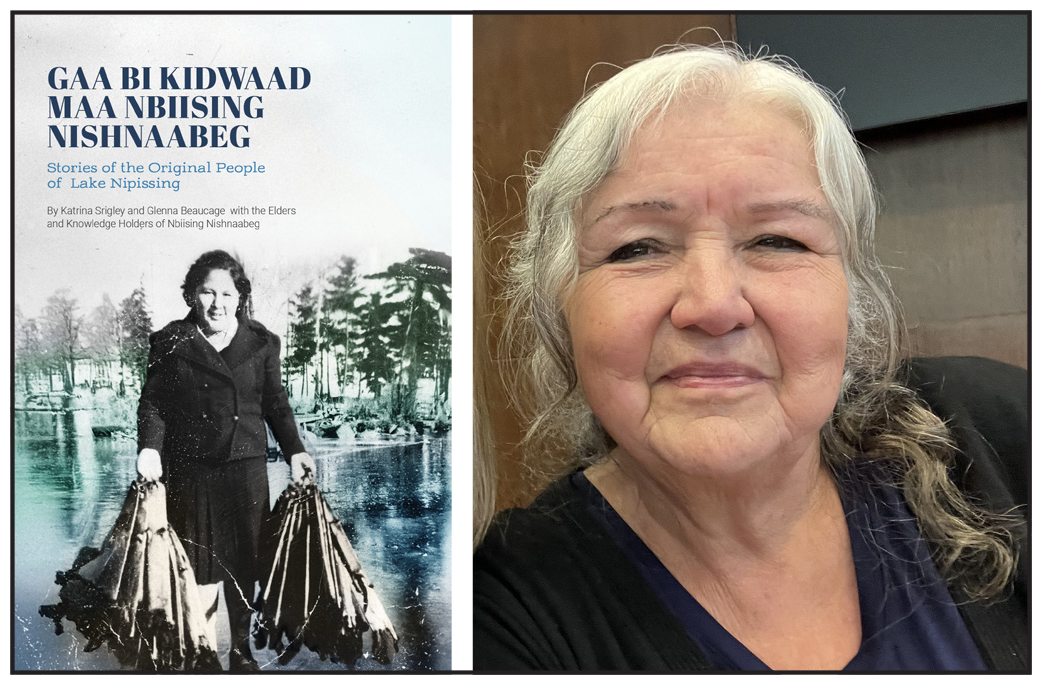
Image Caption
Windspeaker.com Books Feature Writer
Local Journalism Initiative Reporter
Gaa Bi Kidwaad Maa Nbiising Nishnaabeg: Stories of the Original People of Lake Nipissing is sharing the collective and personal truth of the territory to the Nbiising community and non-Indigenous people.
“Knowing truth is a big part of community development, one person at a time, one group at a time,” said co-author Glenna Beaucage.
The truth is that Nbiising Nishnaabeg were a thriving people before colonization, and they survived the impacts that colonization have had.
For non-Indigenous people, “if you really want to set yourself free and be an evolved citizen in learning about our traditional territory, you really have to start letting go of the fear of finding out the truth.”
“The stories that follow bring us into these spaces to help us understand what happened, to establish the truth, and give us direction for moving forward in a good way,” write Beaucage and co-author historian Katrina Srigley.
Community meetings, discussion panels, safe spaces, announcements in newsletters, and family outreach took place over 16 years allowing people to share their stories and personal archives which form the bulk of the book.
However, the foundation for Gaa Bi Kidwaad Maa Nbiising Nishnaabeg was started almost 50 years ago.
After having left university in her second year because of chronic shyness, Beaucage returned home to Nipissing First Nation (NFN). She spent time on the French River and Lake Nipissing and in the bush “trying to learn here because I really wanted to learn culture and become stronger that way.”
In her twenties, she started collecting articles from magazines and publications that her late father Chief Fred McLeod Jr. was receiving. They outlined the work of Indigenous people like Chief Dan George, and organizations like the American Indian Movement (AIM).
She was also working at NFN’s library. She became aware that there was little heritage or historical material about Nbiising, so she started collecting that material with a strong focus on Anishinaabeg literacy, nbiising nishnaabemwin.
By then, Beaucage had accumulated two large cardboard boxes of material.
“I had a dream to write a book. It is a dream because I thought, ‘I have all the information, I know the land, I know the people, and I remember most of the things that happened or heard of them’,” said Beaucage. “I had to use a lot of tobacco. I offered a lot of semaa for direction. I said, ‘Bring me where I'm supposed to be with this’ because I didn't really know.”
It was then that she connected with Srigley at Nipissing University. She is of western European descent.
The two balanced each other, with Beaucage a community member and Srigley an established author and researcher. They formed a close and respectful relationship.
Elders and Knowledge Holders of Nbiising Nishnaabeg also contributed to the book. A wide array of photographs highlight the written word along with a glossary of nbiising nishnaabemwin.
Beaucage thought she had a good start on Gaa Bi Kidwaad Maa Nbiising Nishnaabeg based on everything she had gathered over the years. However, after categorizing the information and forming chapter headings, she soon came to realize that gaps needed to be filled by stories from community members.
“I felt in order to create that story of continuity and being inclusive of people, we had to take a step back and wait for things to come together,” she said, although she readily admits she didn’t anticipate it taking 16 years.
“I created spaces and opportunities for people to say what they had to say. The community guided us and our book just sat there saying, ‘We're not done yet,’” said Beaucage.
The methodology used to collect information from both community members and archives is carefully detailed.
For a small community of around 3,000, Beaucage says there are a “lot of intricacies.” And while every effort was made to invite people to come forward with photographs, documents and stories, not everyone did.
Many oral stories were supported by archival material. Archival material included personal letters or community archives, as well as state-based and non-Indigenous voices.
“The stories are really important. Having that legitimacy of the archive is also important,” said Beaucage.
However, she stresses that archival support wasn’t required to legitimize stories, noting that “our lives were always communicated to the world through another culture's treaties and their papers and their media. It was never in our favour because the eye was on the land and the resources, so we were in the way.”
Beaucage says the stories she had the hardest time hearing were those about residential schools.
“It was really emotional for me to learn that people, peers of mine that I saw socially and lived with every day, harboured those harsh and sad memories. All these years, they never spoke to them,” she said.
The research for the book gave residential school survivors a safe platform to tell their stories. At the same time, Beaucage notes, residential school survivors across the country were opening up to the Truth and Reconciliation Commission on Indian residential schools.
“And now I see (Nbiising residential school survivors)…out in the community on Orange Shirt Day. They're being asked by schools to come and tell their stories,” she said.
Gaa Bi Kidwaad Maa Nbiising Nishnaabeg is comprehensive. Both dbaajmowinan (everyday stories) and aansokanan (sacred stories) of Nbiising Nishnaabeg are at the centre of the teaching and learning relationships generated and sustained on Nbiising lands and waters. The book spans pre-contact, the impact of settler colonialism, and finishes with a look at moving forward that centres on education, both traditional and formal.
Capturing these stories, said Beaucage “is probably going to create some long-awaited understanding in the world.”
“One of the things that uplifted (me) was being entrusted in the first place with these stories and people's lives. And I was uplifted learning more about my own identity because I carried that, too, in high school that, I guess, that somehow we were less,” she added.
“I'm also uplifted because it started off with a cardboard box full of paper. And then a dream came true. (It) was always there and it created us putting together, a page at a time out of that box, to put together a really beautiful story of the Nipissings that were put here generations ago. And those stories can come alive now and be here for generations to come.”
A pilot project is already underway with topics being extracted from the book to be developed for curriculum for Nbissing Secondary School. Beaucage says they want to see curricula from the book rolled out to other schools, including provincial schools, such as in North Bay and Sudbury, where there is a high attendance of northern Cree and Ojibwe students.
It’s important, says Beaucage, that young people understand that Elders “were under assault every day and they did their best to survive that black cloud. And they were under siege and they survived. They fought their hardest battle. Not 100 per cent intact, but mostly. We have to continue to rebuild.”
She is hopeful that with understanding comes forgiveness.
Non-Indigenous people also need to understand, Beaucage said, “and accept the reality of this territory. There's so many stories on this land and these waters, they're going to be there forever. No matter who tries to paint over their pictographs, the truth remains deep in Mother Earth.”
All proceeds from the book, which Beaucage refers to as “my labour of love,” will be going to language revitalization and literacy.
Gaa Bi Kidwaad Maa Nbiising Nishnaabeg: Stories of the Original People of Lake Nipissing, published by the University of Manitoba Press will be launched Nov. 20 at Nbissing Secondary School. It can be purchased through https://uofmpress.ca/books/gaa-bi-kidwaad-maa-nbiising-nishnaabeg