
Image
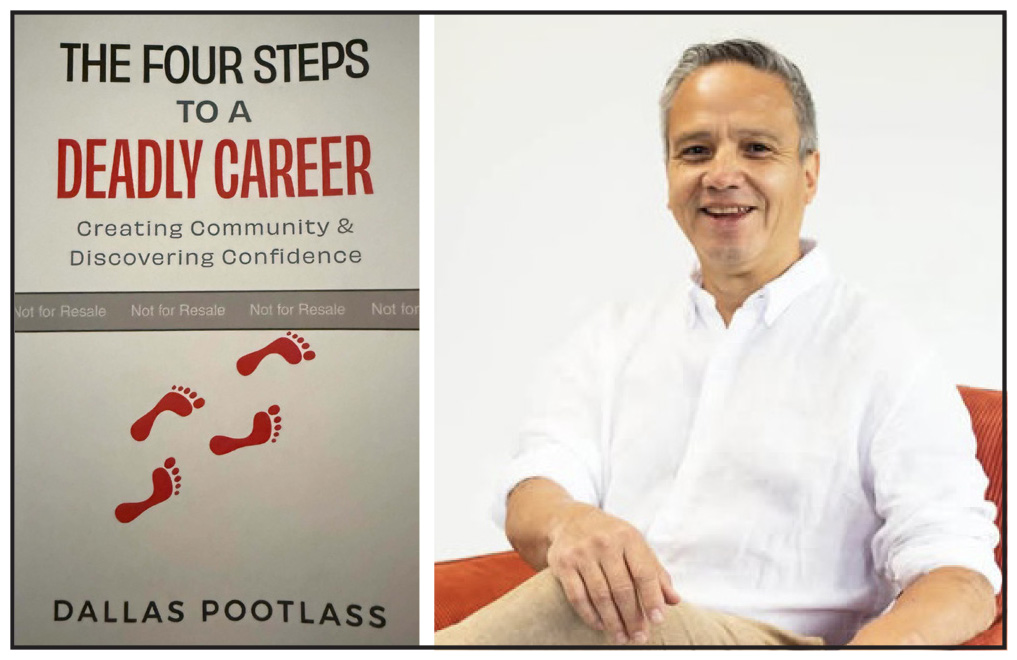
Image Caption
Windspeaker.com Books Feature Writer
Local Journalism Initiative Reporter
For the last 10 years, Dallas Pootlass has coached Indigenous learners on how “to stay horizontal in a vertical world,” as he states in his new book The Four Steps to A Deadly Career: Creating Community & Discovering Confidence.
“I think that we're suffering from a British hangover. There's a lot of the systems that are in place that have been colonized by the Brits…We've inherited that hierarchical ‘let's-climb-this-corporate-ladder-even-if-the-wall-that-it's-leaning-against-doesn't-really-align-with-who-you-are’ system,” Pootlass told Windspeaker.com.
Pootlass, who is from the Nuxalk Nation on British Columbia’s central coast, says people don’t question the system, which they “a hundred per cent” should.
The Four Steps to A Deadly Career is “the Blueprint” Pootlass has followed since he began his career coaching work.
“When I developed the Blueprint…it was a way to simplify and honor the management of the self: your identity, your values, and your direction in life,” he writes. “I firmly believe that the answers you seek are already inside of you. My role as a guide…(is) to help you uncover what you already carry.”
Over the years he has tweaked that blueprint based on feedback he has received from the approximately 1,500 clients, primarily Indigenous, with whom he has worked.
“I had to really refine my skills and make (the Blueprint) a little bit of an easier pill to take,” said Pootlass.
One of those changes was presenting the four steps as “management containers.” The four containers, in order, are self-management, team management, strategic management, and wellness management. Each container builds on the ones before it.
“I’m a firm believer that self-awareness is the foundation of everything; it’s what supports you in simplifying your life, clarifying your values, and making choices that truly align with who you are,” Pootlass writes.
Team management, the second container, is realized through the Blackfoot concept of community actualization, writes Pootlass. Individual growth is celebrated by how it contributes to the community as a whole.
The third container, strategic management, is about aligning strategy with self-awareness and intentional choice. It centres around the personal definition of success.
“When we start to think generationally, about what we pass on…it becomes something bigger than personal gain. It becomes about stewardship, legacy, and healing,” he writes.
The fourth and final container is wellness management. Pootlass defines this as relational. “It’s about how we treat each other, our families, and our communities.”
He also links ending lateral violence with wellness management, something he feels strongly about.
Bringing the four management containers together can be difficult, he says, pointing out that “no one seeks coaching when everything is perfect.”
He’s had push back, he admits.
“I think people resist things until they know the benefits that they can get from doing something. That's the resistance,” said Pootlass. “Everybody listens to a radio called WIIFM. What's In It For Me?”
He says he’s been accused of “toxic positivity” by some clients who are tuned into social media with its toxic negativity.
Pootlass points out that growth is cyclical not linear, and nobody should expect perfection. People need to be kind to themselves. It’s something he understands personally.
“I participated in group coaching and… when I thought, ‘Oh, okay, this is it. I've arrived. It's my new normal.’ Then there's something else. I tell people that it's like whack-a-mole. All of those character traits that I have, they pop up and I'm just trying to whack them, right? And then there's something new and I’m ‘okay, I hadn't heard that before’ or ‘I heard that before, but it didn't really land for me the last time I heard it.’ Then it brings up a new challenge,” said Pootlass. “I always tell people I have problems that are worthy of who I am now.”
Coaching, he says, is about asking the right questions, not delivering the “truth.”
The Four Steps to A Deadly Career includes questions readers should ask themselves and practical tools. It ends with an introduction to the Four Totems of Leadership which, Pootlass says, is next in moving forward in a good way.
Turtle teaches that leadership does not always require speed and that “cultural grounding can carry us through the complexities of our roles and responsibilities.”
Wolf shows that leadership has a responsibility to the collective.
Bear teaches that leadership is about encouraging people to find their own solutions and trusting that they can.
Eagle is a reminder to “rise above the noise” and see the situation without judgement or defensiveness. It provides clarity.
The Four Steps to A Deadly Career: Creating Community & Discovering Confidence was released mid-June. It can be purchased at https://lifesizedpublishing.com/book/the-four-steps-to-a-deadly-career-creating-community-discovering-confidence/