
Image
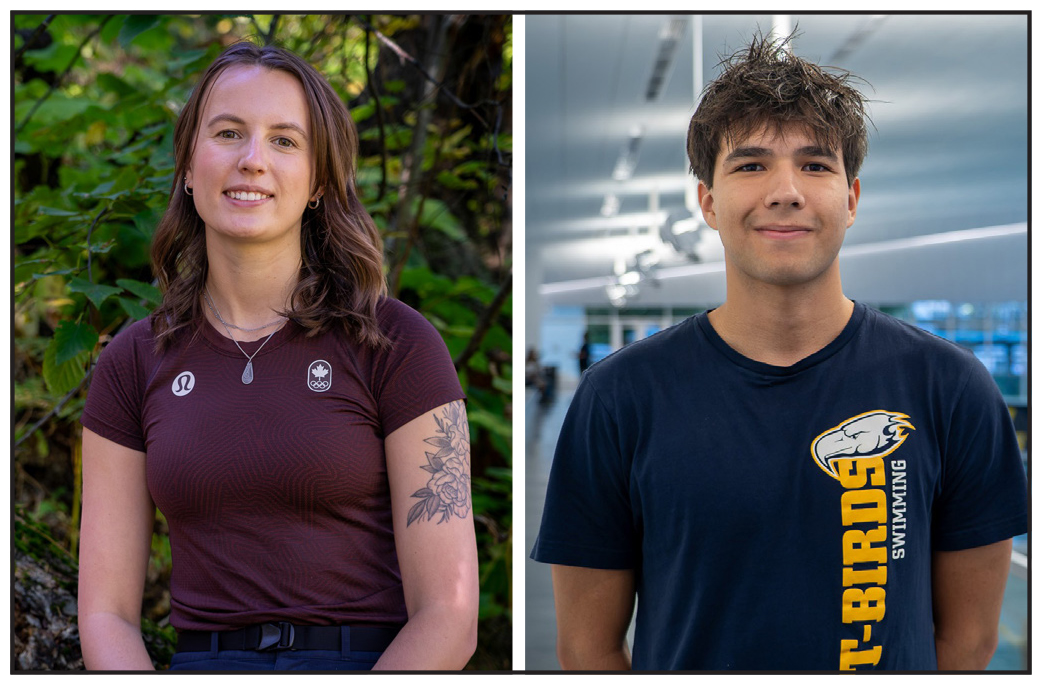
Image Caption
Local Journalism Initiative Reporter
Windspeaker.com
A two-time Olympian and a first-year university student are Canada’s top Indigenous athletes this year.
Trinity Ellis, a citizen of the Métis Nation British Columbia, represented the country in luge at the last two Winter Olympics. She is the top the female recipient of the national Tom Longboat Award.
Swimmer Tuja Dreyer, a member of Kaska Dena Nation in Yukon, is continuing his academic/athletic career at the University of British Columbia. He was chosen as the national male winner.
Both Ellis and Dreyer received their awards at the National Indigenous Sports Gala on Oct. 24 in Ottawa.
The Tom Longboat Awards, annually presented by the Aboriginal Sport Circle, the country’s governing body for Indigenous athletics, are named in honour of the legendary long-distance runner from Six Nations of the Grand River in Ontario.
Longboat won the prestigious Boston Marathon in 1907 and also represented Canada the following year at the Summer Olympics in London, England.
The Tom Longboat Awards program was established in 1951 to recognize Indigenous athletes for their outstanding contributions to sport.
Besides the two national winners, female and male provincial and territorial winners were also recognized at the Ottawa gala.
Ellis, who finished 17th in the women’s luge competition at this year’s Milan Cortina Olympics in Italy, was pleased she was chosen.
“It's such an honour,” she said. “It was really an amazing experience this weekend going to the gala and getting to meet all of the recipients and the whole larger (Indigenous sports) community. It was really amazing. I haven't quite wrapped my head around it yet.”
Ellis, who is 24, also competed at the 2022 Beijing Olympics in China. She placed 14th in the women’s competition and also helped Canada to a sixth-place finish in the mixed relay event.
Ellis said she hopes winning her award and attending the national gala will bring more recognition to her sport.
“I always love getting to go to events like that and teach people about luge and put it on their radar because it is a very small and niche sport,” she said. “And I just love sharing my love for it.
“It's pretty awesome to be able to represent that small but mighty luge community. And I hope maybe it reaches some kid who thinks that would be really fun.”
Ellis hopes to compete in future Olympic competitions, but she’s not devoting her life full-time to the sport during the 2026-27 season.
She plans to only participate in two World Cup events this season, first in South Korea in December and then in France in February.
That’s because she’s started a two-year environmental science and planning program at Selkirk College in Castlegar, B.C.
She’s a 30-minute drive from the school, living in the city of Nelson.
“I'm taking a bit of a modified season and doing a year of school,” Ellis said. “It's hard to do both and especially in our sport when we spend most of the winter in Europe. After these past Olympics, I decided to take a bit of a step back for the next year and do some school.”
Ellis plans to return to the World Cup circuit on a full-time basis for the 2027-28 season. She said it makes sense to go back to school now, as it is the first year of a four-year Olympic cycle.
“The first year of the quad is always the time to do anything, if there ever is a time,” she said.
Ellis is hoping to represent Canada at the 2030 Winter Olympics, which primarily will be held in France.
Based on her previous Olympic results, she believes she’s capable of a Top 10 finish.
“That's definitely the goal,” she said. “I feel the past two Olympics I had that potential. And I wasn't really able to perform to my best on the day. There’s a lot of experience and learning that I've gained through my career and I'm definitely hungry to put that into action.”
Ellis said she also has short-term goals she’d love to accomplish.
“Looking at the next couple of World Cup seasons, I hope to make some progression there,” she said. “It's exciting. Luge Canada has had like a full program revamp basically with some new coaches. And so, it's kind of exciting to see if we can unlock some more performance.”
Ellis attended the national sports gala with her mother Shannon Didier.
“It was really awesome to have her there,” she said. “She’s probably been my biggest supporter throughout my athletic career. So, it was really great to have her there and share that experience with her.”
As for Dreyer, who is 18, he was surprised to win his national award.
This marked the second year in a row a swimmer was named as the male recipient. Apollo Hess, a member of Kainai Nation in Alberta, was the 2025 winner.
Dreyer knew he had been nominated for the Yukon regional award but did not envision following in Hess’ footsteps—or more accurately swim strokes.
“He's an Olympian,” Dreyer said of Hess, who participated in the 2024 Games in Paris. “He's a top level-swimmer. He's one of the best ones out there. So, I kept that in mind and had low expectations because I know there's a lot of Olympians and incredible Indigenous athletes out there.”
Dreyer realizes he will now be viewed as a role model himself.
“I think winning this award does come with responsibility,” he said. “And when you win something like this, you have to reflect on it and think about what you can do back in your community and sort of bring it like full circle.”
Dreyer started making a name for himself when he captured six gold medals at the 2023 North American Indigenous Games, primarily staged in Halifax.